Australian pool owners lose between 3mm and 7mm of water to pool evaporation every summer day. That’s not a slow drip – it’s roughly 7,000 to 15,000 litres vanishing from a standard 50,000-litre pool each year. With water restrictions tightening and scheme water costs climbing, understanding how to reduce evaporation isn’t just environmentally responsible – it’s financially sensible.
Evaporation accelerates in Australia’s climate because of the combination of high temperatures, low humidity, consistent winds, and relentless sunshine. Unlike rainwater losses (which can’t be controlled) or leaks (which can be fixed), evaporation is a constant, predictable drain that responds well to targeted prevention strategies. The right approach can cut water loss by 50% to 95%, depending on the methods chosen.
This guide explains the science behind pool evaporation, the factors that speed it up in Australian conditions, and the most effective prevention strategies – from liquid covers and physical barriers to landscaping adjustments and equipment upgrades.
Why Australian Pools Lose So Much Water to Evaporation
Evaporation occurs when water molecules at the surface gain enough energy to break free and become vapour. The rate depends on four environmental factors: temperature, humidity, wind speed, and sun exposure.
Australia’s climate delivers a perfect storm for evaporation. Summer air temperatures regularly exceed 35°C, while pool water sits between 24°C and 28°C. That temperature difference drives rapid evaporation. Low humidity – often below 30% in summer afternoons – means the air is “thirsty” and readily absorbs moisture. Coastal breezes and inland winds accelerate the process by constantly replacing saturated air above the pool surface with dry air. Finally, many Australian regions receive more than 3,000 hours of sunshine annually, which heats the water and increases molecular activity.
A pool with 50 square metres of surface area can lose 350 litres on a hot, windy day. Over a summer, that’s enough to fill a small above-ground pool. For property managers overseeing multiple pools or strata committees managing community facilities, those losses compound quickly.
The Hidden Costs of Unchecked Evaporation
Water loss isn’t just about topping up the pool. Every time scheme water gets added, carefully balanced chemistry becomes diluted. Fresh water in many Australian regions is alkaline and contains minerals that affect pH, total alkalinity, and calcium hardness. Frequent top-ups force more frequent chemical rebalancing, which means higher chemical costs and more time spent testing.
Pool evaporation also concentrates dissolved solids in pools. As water escapes, salts, minerals, and stabiliser (cyanuric acid) remain behind. Over time, total dissolved solids (TDS) climb, which reduces chlorine efficiency, causes cloudy water, and eventually requires partial or full pool draining to correct. Draining a pool wastes even more water and resets chemical balance from scratch.
For strata properties and rental properties, high evaporation rates can trigger compliance headaches. Water restrictions in many regions limit when and how much pools can be refilled, and breaching those limits risks fines. Property managers often discover evaporation issues only after tenants complain about low water levels or after a compliance audit flags excessive water use.
Physical Pool Covers: The Most Effective Solution
A well-fitted pool cover is the single most effective evaporation prevention tool. Physical covers create a barrier between the water surface and the air, eliminating the conditions that drive evaporation. Depending on the cover type, water loss reduction of 90% to 98% becomes achievable.
Solid pool covers are the gold standard. Made from UV-resistant PVC or reinforced vinyl, they sit directly on the water surface or stretch across the pool using tracks or rollers. Solid covers block sunlight (which reduces algae growth), trap heat (which lowers heating costs), and prevent debris from entering the pool. They’re ideal for pools that aren’t used daily or for properties that close pools seasonally.
Bubble covers (also called solar blankets) are lighter and more affordable. They resemble industrial bubble wrap, with air pockets that provide insulation and buoyancy. Bubble covers reduce pool evaporation by 70% to 90% and can raise water temperature by 5°C to 8°C through passive solar heating. They’re easy to roll on and off, making them practical for homeowners who use their pools regularly. The trade-off is durability – bubble covers degrade under UV exposure and typically last two to four years.
Automatic pool covers are a premium option. Mounted on tracks, they retract into a housing at one end of the pool and extend at the push of a button. Automatic covers offer the same evaporation reduction as solid covers but with far greater convenience. They’re particularly valuable for strata complexes and commercial properties, where manual cover deployment is impractical. The upfront cost is significant – often $8,000 to $15,000 for residential installations – but the long-term water and chemical savings justify the investment.
One common mistake is leaving covers off during the day to “let the pool breathe.” Pools don’t need air circulation. Leaving a cover on during peak evaporation hours (10am to 6pm) delivers the greatest water savings. If heat buildup is a concern, choose a light-coloured or reflective cover that reduces solar gain while still blocking evaporation.
Liquid Pool Covers: The Low-Maintenance Alternative
Liquid pool covers are an invisible layer of biodegradable molecules (typically fatty alcohols) that float on the water surface and reduce pool evaporation by 30% to 50%. The liquid gets added to pools weekly or monthly, and it spreads to form a microscopically thin film that slows water molecule escape without affecting water chemistry, filtration, or swimming comfort.
Liquid covers work best for pools that see frequent use, where physical covers are inconvenient. They’re also useful for irregularly shaped pools, spa pools, or water features where traditional covers don’t fit. The film is invisible, odourless, and safe for swimmers – most users don’t notice it’s there.
The downside is effectiveness. Liquid covers can’t match the 90%-plus reduction of physical covers, and they require regular reapplication. Wind and splashing break up the film, so high-traffic pools or pools in exposed locations see diminished results. Liquid covers also don’t provide the secondary benefits of physical covers, such as debris protection or heat retention.
For residential pool care clients who want a “set and forget” solution, combining a liquid cover with other evaporation strategies – such as windbreaks or shade structures – rather than relying on it alone often proves most effective.
Windbreaks and Landscaping Adjustments
Wind is one of the most underestimated drivers of evaporation. A 20km/h breeze can double a pool’s evaporation rate compared to calm conditions. Installing a windbreak reduces wind speed across the water surface, which slows evaporation and makes pools more comfortable to use.
Natural windbreaks – such as hedges, shrubs, or trees – are the most aesthetically pleasing option. Dense, evergreen plants like Lilly Pilly, Viburnum, or Pittosporum work well in Australian conditions. Plant them on the prevailing wind side (varies by location) at least two to three metres from the pool edge to avoid root intrusion and leaf litter. A 2-metre-high hedge can reduce wind speed by 50% for a distance of 10 to 15 metres downwind.
Structural windbreaks – such as fences, screens, or pergolas – offer immediate results. Glass or acrylic panels provide wind protection without blocking sightlines, while timber or metal screens add privacy. Retractable shade sails can double as windbreaks when positioned correctly. The key is to avoid creating a wind tunnel effect; solid barriers should have some permeability (e.g., slatted screens) to prevent turbulence.
One caution: windbreaks that also provide shade can reduce natural pool heating, which may be desirable in summer but less so in winter. If pool heating is used, position windbreaks to block wind without eliminating all sun exposure.
Shade Structures and Sun Exposure Management
Reducing direct sunlight lowers water temperature and slows the evaporation process. Shade structures – such as pergolas, shade sails, or retractable awnings – can cut pool evaporation by 20% to 40% when used in combination with other strategies.
Shade sails are popular across Australia because they’re cost-effective, versatile, and UV-rated. A well-positioned sail can cover 50% to 70% of pool surface during peak sun hours (11am to 3pm) while still allowing morning and late-afternoon light. Choose light-coloured fabrics to reflect heat rather than absorb it.
Pergolas and gazebos offer permanent shade and can integrate with outdoor living areas. Pair them with climbing plants (like jasmine or wisteria) for additional cooling and aesthetic appeal. Pergolas work particularly well for lap pools or plunge pools, where full coverage is practical.
Deciduous trees provide seasonal shade – full coverage in summer when needed, and bare branches in winter to allow solar heating. However, trees near pools require careful selection. Avoid species with invasive roots, heavy fruit drop, or excessive leaf litter. Consult a local arborist to choose pool-friendly varieties.
One trade-off: shade reduces evaporation but also limits passive solar heating. If reliance on the sun to warm the pool exists, balancing shade coverage with heating needs becomes necessary. For clients with pool equipment such as heat pumps or gas heaters, shade structures make more sense because they reduce evaporation without compromising comfort.
Pool Design and Surface Area Considerations
Evaporation is directly proportional to surface area. A pool with 60 square metres of surface area loses 20% more water than a 50-square-metre pool under identical conditions. If building a new pool or renovating an existing one, design choices can significantly impact long-term water use.
Compact pool shapes (such as plunge pools, lap pools, or geometric designs) minimise surface area relative to volume. A 4m x 10m lap pool has less surface area than an 8m x 8m pool of similar volume, which means lower evaporation and reduced heating costs.
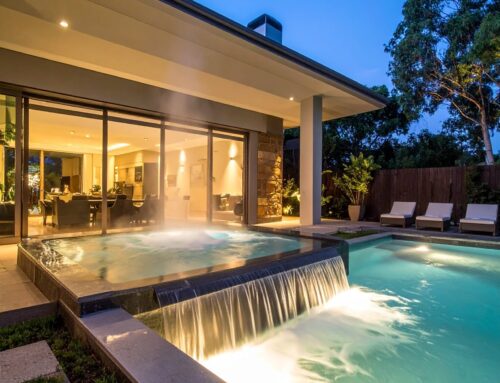
Raised pool edges or infinity edges increase exposed surface area and accelerate pool evaporation. Infinity pools, in particular, lose water from both the main pool and the catch basin. If aesthetics demand these features, plan for higher water use and budget for more frequent top-ups.
Integrated spas and water features add surface area and turbulence, both of which increase evaporation. A spa with jets running can lose water 50% faster than a still pool. If a spa exists, cover it when not in use and limit jet operation to actual use periods.
For property managers and strata committees evaluating pool upgrades, reducing surface area or adding covers should be part of any water conservation plan. The upfront cost is offset by long-term savings on water, chemicals, and pool equipment wear.
Equipment Adjustments to Reduce Water Loss
Pool equipment setup can either exacerbate or mitigate evaporation. Small adjustments to filtration, heating, and water feature operation can yield measurable savings.
Run filtration systems during off-peak evaporation hours. Filtering during the hottest part of the day agitates the water surface and increases evaporation. Instead, run pumps in the early morning or late evening when temperatures drop and humidity rises. Most modern variable-speed pumps allow programming run times for maximum efficiency.
Lower pool water temperature. Heated pools evaporate faster because warm water molecules have more energy. Dropping heater setpoint by 2°C can reduce pool evaporation by 10% to 15% without significantly affecting comfort. For commercial pools, consider seasonal temperature adjustments – cooler water in summer, warmer in winter.
Reduce waterfall and fountain operation. Water features are beautiful, but they dramatically increase evaporation by creating turbulence and exposing more water to air. Run features only when the pool is in use, and turn them off overnight and during peak heat. A waterfall running 24/7 can double a pool’s evaporation rate.
Check for leaks regularly. Evaporation and leaks are often confused. If a pool loses more than 7mm per day, or if water loss continues even with a cover on, a leak likely exists. A simple bucket test – comparing water loss in a covered bucket to pool water loss – can help diagnose the issue. If a leak is suspected, professional pressure testing and inspection becomes necessary.
Monitoring and Measuring Evaporation
Managing what isn’t measured proves impossible. Tracking pool evaporation rate helps assess whether prevention strategies are working and identify problems early.
The bucket test is the simplest method. Fill a bucket with pool water, mark the water level, and place it on pool steps (weighted down so it doesn’t tip). Mark the pool’s water level at the same time. After 24 hours, compare the water loss in the bucket (evaporation only) to the pool’s water loss (evaporation plus any leaks). If the pool loses significantly more water than the bucket, a leak exists.
For more precise tracking, install a pool water level monitor. These devices attach to pool walls and measure water level changes over time. Some models integrate with smart home systems and send alerts when water loss exceeds normal rates.
Keep a log of water additions, weather conditions, and cover usage. Over time, patterns emerge – such as higher evaporation on windy days or after uncovered pool parties – that inform better management decisions.
Combining Strategies for Maximum Impact
The most effective evaporation prevention plans layer multiple strategies. A physical cover alone can reduce water loss by 90%, but combining it with a windbreak, shade structure, and equipment adjustments can push savings even higher while improving pool usability and comfort.
For example, a residential pool client installed a bubble cover, planted a Lilly Pilly hedge along the eastern fence line, and adjusted pump run times to early morning. The result: a 75% reduction in water use, lower chemical costs, and fewer algae blooms during summer. The upfront investment – roughly $1,200 for the cover and hedge – paid for itself in 18 months through reduced water and chemical bills.
For strata properties, automatic covers paired with shade sails and equipment upgrades deliver the best return. The convenience of automatic covers ensures compliance (residents actually use them), while shade sails reduce heat load and improve outdoor amenity. Budget for professional installation and regular maintenance to maximise lifespan and effectiveness.
When to Seek Professional Advice
Evaporation prevention isn’t one-size-fits-all. Pool size, location, usage patterns, and budget all influence the best approach. If uncertainty exists about where to start, or if current strategies aren’t delivering results, professional guidance saves time and money.
Professional pool services work with homeowners, property managers, and strata committees to assess evaporation issues and recommend tailored solutions. Evaluation of pool exposure, measurement of water loss, and design of prevention plans that balance effectiveness, convenience, and cost all factor into comprehensive assessments.
Whether help is needed selecting the right cover, adjusting equipment settings, or troubleshooting unexplained water loss, professional inspection provides clarity. Walking through the options and implementing strategies that work for specific situations ensures optimal results.
Conclusion
Pool evaporation is the silent thief of Australian pool ownership – steady, predictable, and expensive if left unchecked. But it’s also one of the most controllable sources of water loss. Physical covers, windbreaks, shade structures, and equipment adjustments can cut evaporation by 50% to 95%, reducing water bills, chemical use, and environmental impact.
The key is to start with the highest-impact strategy – a quality pool cover – and layer additional measures based on the pool’s specific challenges. Track results, adjust as needed, and don’t hesitate to seek professional advice when water loss exceeds normal rates or when upgrades are being planned.
Indigo Pool Care specialises in water conservation strategies for rental properties and residential pools across Australia. Professional assessment identifies the most effective evaporation prevention methods for specific pool conditions, ensuring maximum water savings and reduced operating costs.
Australia’s climate isn’t changing, but the approach to pool water conservation can. With the right strategies in place, less time gets spent topping up pools and more time enjoying them. Contact us today to schedule an evaporation assessment and discover how much water and money can be saved with targeted prevention strategies.